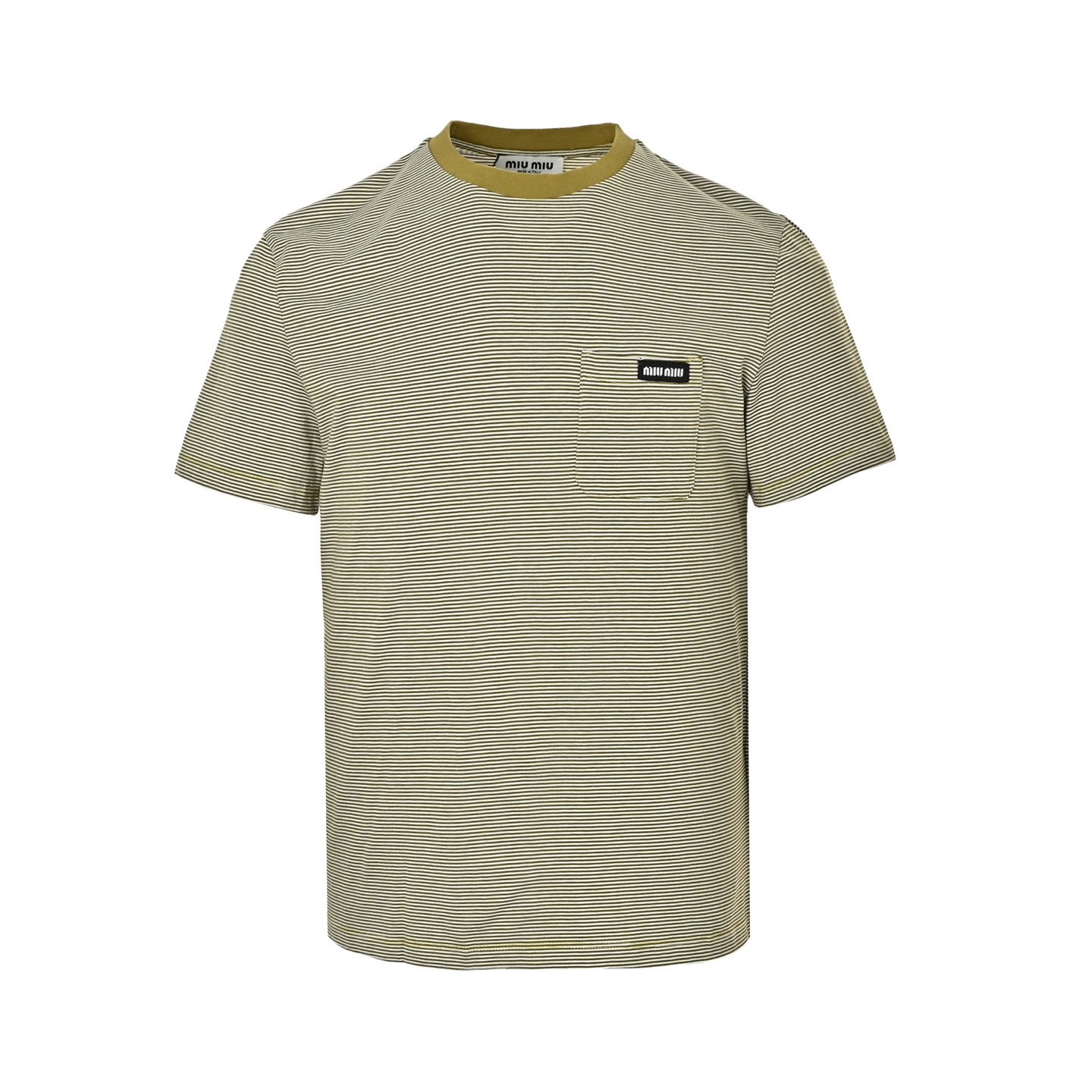
Miu Miu/Miu Miu mustard yellow collar striped short sleeves
The fabric is made of high-density yarn-dyed fine-striped knitted fabric with uniform wide and narrow textures. It is highly visible to the naked eye and greatly raises the threshold of cutting and sewing technology. Different from the random cutting of solid-color fabrics, striped models must accurately position the texture reference line at the cutting stage. When cutting the front, back and left sleeves, the horizontal stripes must be aligned at the same height. The single-piece cutting deviation must not exceed 0.1cm. Once the lines are misaligned, the visual layering of the garment will be directly damaged. The left chest patch pocket is the most difficult area in the whole garment process. The stripes of the bag itself need to be leveled and sewn independently. When fitting the front piece of the body, the horizontal strips of the bag must be seamlessly connected with the stripes of the body. Before sewing, the direction of the lines must be manually and repeatedly compared with multiple fixed points using positioning clips to eliminate the height of the stripes at the pocket splicing. There is a problem of skewing and misalignment. If the strips are not properly controlled, cracks will appear in the patch pocket area, which will destroy the overall regularity of the fabric. The mustard yellow contrasting ribbing on the neckline also matches the body stripe benchmark. The round neckline connects the front and rear pieces at the neckline breakpoints. The transverse grains need to surround the neckline and connect naturally and smoothly to the collar. Strict tightness control on sewing threads may cause fabric to be pulled if it is too tight. If the stripes are stretched and deformed too loosely, the texture will be loose and misaligned. The closed-loop alignment of the neckline will test the craftsman's touch and proficiency. The side seams and sleeve bottoms will continue to be stitched together. The standard sleeve hem stripes and the horizontal stripes of the body side seams will correspond one-to-one. The double-layer cutting strips on the inside and outside will overlap and align. Feed the fabric at a constant speed during sewing to avoid uneven pushing of the fabric, causing fabric slippage. The stripes will shift and the hem will roll.During the sewing stage of edge cuff closing, it is also necessary to control the cutting width with reference to the overall stripe horizontal line to ensure that the upper and lower lines are highly unified. The entire strip matching process cannot rely on a machine to complete most of the key splicing points with one click. Most of the key splicing points rely on manual point-by-point calibration and repeated comparison and positioning. From the positioning of single piece cutting points on the cutting bed to the splicing and sewing, every process must be The stripe baseline is used as a reference for layer-by-layer control, and the fine-grained stripe tolerance space is extremely low. Minor deviations will be visually revealed on the surface of the garment. It takes longer work to calibrate the pattern arrangement and relies on refined manual control to achieve coherent and regular patterns on the entire garment. Restore the strict craftsmanship of the brand's garments, and create high-end workmanship from low-key and simple striped styles. Size:1/XS 2/S 3/M 4/L Coding: 2026#YS2800624